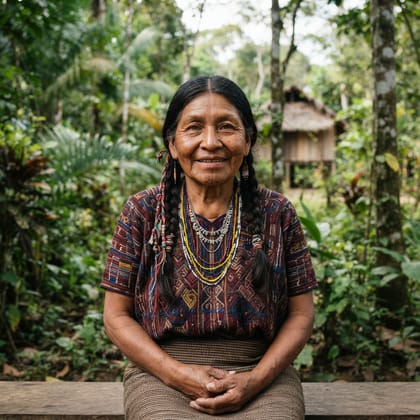
The Lowland Quechua of Colombia

The Lowland Quechua of Colombia, numbering approximately 475 people, are No Longer Unreached. They are an Eastern Tucanoan Indigenous people of the Apaporis and Pirá-Paraná river basin of the Colombian Amazon whose identity is rooted in exogamous clan traditions, communal maloca life, and stewardship of rainforest territories. They mostly adhere to Ethnoreligion and Napo Lowland Quechua is their primary language.

Photo by Google. (2026). Image generated by Gemini 3.1 Flash-Lite: Quechua, Lowland

Fast Facts:

Affinity Group: Latin American and Caribbean Peoples
Country: Colombia
People Cluster: Quechua
Primary Language(s): Napo Lowland Quechua (qvo)
Primary Religion(s): Ethnoreligion
Population: 475
Strategic Progress Index (SPI): No Longer Unreached
Global Status of Evangelical Christianity (GSEC): 10% or Greater Evangelical
People Group ID: PG043719
View on Joshua Project

Pray for the Lowland Quechua of Colombia

Join others around the world in praying for the lost to be saved, the gospel to advance, the global Church to grow, and for laborers to be sent out and sustained in the harvest.

Dig Deeper (Religion):

Primary Religion: Ethnoreligion
Religious Affiliation: Ethnoreligion

—
%
Ethnoreligion Adherents

Dig Deeper (Language):

Primary Language: Napo Lowland Quechua
Language Family: Quechuan

100%
%
Quichua, Napo Speakers

Media Resources in Napo Lowland Quechua:

Films:

No film resources are listed for this language.

Bible Resources in Napo Lowland Quechua:

Bible Name (Translation)VideoAudioText
Colegio Don Bosco✓✓

1 entry

Or check out the Napo Lowland Quechua bible at Bible.com

Linked from YouVersion

SPI: No longer Unreached

The Lowland Quechua are No Longer Unreached, which means there are more than 2% evangelical Christian populations and there are churches consistent with evangelical faith and practice. There is still more to be done among them.

Next steps for the Lowland Quechua:
Empower local believers to begin praying for their own people
Continue gospel seed sowing and church planting
Encourage local leaders to being leading church planting strategy and looking for Unreached and Unengaged groups nearby

Pray specifically for the Lowland Quechua of Colombia

Ah, Lord GOD! It is you who have made the heavens and the earth by your great power and by your outstretched arm! Nothing is too hard for you.
readJerremiah 32:17

Pray that the God who made the heavens and the earth by the power of His outstretched arm, the One who is able to save those who are lost, will show His great love and mercy to those who are walking in darkness.

Behold, you shall call a nation that you do not know, and a nation that did not know you shall run to you, because of the LORD your God, and of the Holy One of Israel, for he has glorified you.
readIsaiah 55:5

Pray that those who do not know God will access the gospel, run to Him, and discover that He is the one their souls have been longing for.

For the LORD takes pleasure in his people; he adorns the humble with salvation.
readPsalm 149:4

Pray that as people place their faith in Christ, they will be encouraged and feel immeasurably loved as they meditate on the fact that God takes pleasure in them.

After this I looked, and behold, a great multitude that no one could number, from every nation, from all tribes and peoples and languages, standing before the throne and before the Lamb, clothed in white robes, with palm branches in their hands, and crying out with a loud voice, “Salvation belongs to our God who sits on the throne, and to the Lamb!”
readRevelation 7:9-10

Pray that the promise in Revelation 7:9-10 will encourage believers from among them or from nearby people groups to share the gospel with people who have never learned it.

Quichua, Napo Lowland Across Countries (ROP3 - 105887) reported in the following countries:

Strategic Progress Index
All

3 people groups

To download a comprehensive people group list in spreadsheet form, visit our Research Data page.

Peoplegroups.org relies on updates from the field and other organizations for much of our data, so if you have any updates, please contact us. We use various international naming standards. For a list of these standards and fields, visit our Data Standards section.

Scroll to Top